Understanding the Psychology of Cynicism #5
The Real Reason People Ask: “Which Came First?”
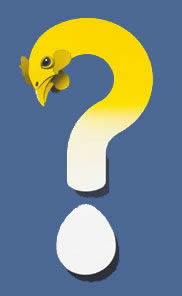
For centuries, people have posed the riddle: “Which came first, the chicken or the egg?” It sounds like a question meant to perplex and entertain. But if you look deeper, you'll discover something far more revealing. This question isn't really asking about poultry or biology at all. Instead, it exposes what a person actually believes about the origin of life, the nature of reality, and the source of truth itself.
The real power of asking: "Which came first, the chicken or the egg" lies not in the impossibility of proving an answer, but in what your answer reveals about your worldview. No one was there to witness the first chicken or the first egg. No scientist can take you back in time to show you the exact moment that either appeared. So the question becomes something else entirely: it becomes a window into your frame of reference.
What Your Answer Really Says
Consider the two common responses to this question:
If you believe the chicken came first, you likely accept the written testimony found in the biblical record of Genesis. Scripture describes God creating the fowls of the Earth before any eggs were laid. This is a theological view of origins grounded in revelation.
If you believe the egg came first, you probably accept the evolutionary model of biology. Evolution proposes that genetic mutations in proto-chickens gradually produced what we now recognize as modern chickens, which then laid eggs. This is a mechanistic view of origins grounded in naturalism.
Neither answer can be proven through experimentation or direct observation. After all, no laboratory can recreate the exact conditions of either creation or evolution. No fossil record can show you the definitive moment when chickens became chickens. What all this reveals is that your answer depends entirely on your pre-existing beliefs about how the Universe works and what authority you trust.
The Deeper Theological Dimension
To understand the real stakes of this question, consider how it translates into more serious theological terrain. The same logical structure appears when asking: "Which came first, Eve or Eve's mother's ovum?"
Suddenly the question becomes unavoidable. You can't sidestep the theological implications. You're forced to decide whether you accept the revelation of Scripture regarding God's direct creation of humanity, or whether you accept a naturalistic explanation for human origins. The chicken and egg paradox is merely a lightweight version of this much heavier question.
Or take it even further: "Which came first, Jesus or Joseph's sperm?" Now you're confronting the virgin birth and the incarnation. No amount of clever wordplay can avoid the core issue. Your answer reveals whether you accept God's promises as revealed in Scripture, or whether you insist on purely natural explanations for all phenomena.
As such, questions about chickens and eggs are pale imitations of these larger mysteries about creation itself.
Why This Question Is Actually a Trap
Here lies the uncomfortable truth, then, about this famous riddle: it's fundamentally a trick question rooted in cynicism. That's because its real purpose isn't to discover truth but, rather, to expose and undermine certainty in others.
When someone challenges you with "Which came first?", their underlying motive isn't to elicit an answer (which by definition is unprovable). Their real goal is actually to reveal what you believe at the deepest level. More troubling still, they often pose it in a way designed to make you doubt whether any real answer exists at all.
This cynical approach to questioning stands in direct opposition to honest intellectual pursuit. An honest person asks questions because they genuinely seek to understand reality. A cynic asks questions to demonstrate that reality can never really be understood, that all positions are equally unprovable, and that therefore your confidence in any answer is simply naive.
The problem with this cynical method is that it confuses legitimate uncertainty with the sheer improbability of discovering genuine truth. Just because you weren't present at the origin of chickens doesn't mean that chickens didn't, in fact, originate in a specific way. And just because something can't be directly observed doesn't make all explanations equally valid.
The Parallel Problem with Falling Trees
The same cynical structure appears in another famous riddle: "If a tree falls in the forest and no one is there to hear it, does it make a sound?"
On first inspection, this seems like an absurd question. Humans aren't the only creatures with eardrums. Are we really to assume that if no humans are present, there are no animals in the forest capable of hearing? The question reveals an unconscious arrogance about human primacy that undermines its own cleverness.
But let's say we accept the hypothetical: imagine a forest with no humans and no animals. The cynic then plays both sides of the coin. According to physics, yes, when a tree collides with the ground, sound waves are produced. A tape recorder could detect these waves. By the scientific definition of sound, the tree absolutely makes a sound.
But then comes the familiar "however." Without a functioning brain to receive and interpret these sound waves, they argue, there is "no completion of the circuit." They invoke a psychological definition of sound that requires consciousness. Since the brain can generate the perception of sound through drugs or mental illness without external stimuli, they insist, we can't definitively prove a falling tree makes a sound.
Round and round they go, like a dog chasing its own tail, totally unconcerned with the sheer incongruity of their reasoning. They've constructed an argument they can't lose because it operates on two different definitions of "sound" simultaneously.
Why Clarity Matters More Than Cleverness
There is real cost to this kind of cynical thinking. Imagine a child asking a parent: "Do you love me?" Now imagine the parent responding with the philosophical equivalent of the falling tree paradox. The parent hems and haws, explaining that while they experience warm feelings, love might just be chemical reactions in the brain, and therefore their affection for the child is merely subjective and unprovable.
What a miserable existence that would be. Why not simply tell your children you love them and hang your hat on it?
This principle applies far beyond parenting. Why go through life constantly looking over your shoulder, afraid that what you believe might be challenged by someone who demands that you examine every possible angle before allowing yourself certainty? Why can't we accept things at face value when the evidence supports them?
A More Honest Answer
The complexities of life and origins are real, but they don't require perpetual paralysis. Both inductive reasoning (observing patterns in the nature world) and deductive reasoning (applying logical principles to life's events) drive us toward reasonable conclusions.
When examining the question of origins, we can acknowledge that God created chickens, which thereafter laid eggs that hatched into chicks. This is consistent with the testimony of Scripture. We can also acknowledge that when a tree falls to the ground, it produces sound waves that travel through air, regardless of whether any ear receives them. These aren't cynical non-answers dressed up in philosophical language. They're straightforward conclusions supported by evidence and reason.
The point isn't to be clever or to win an argument. The point is to think clearly about what you believe and why. That clarity, grounded in genuine inquiry rather than cynical posturing, is the only foundation for understanding anything at all.
More to Explore
The Lost Stories Channel exists precisely because many of us feel that mainstream education, media, and even church teaching have left crucial questions unanswered or actively distorted the truth. When someone asks you: "Which came first?" you now understand what they're really asking. You can respond with confidence, rooted in a genuine framework for understanding truth, rather than accepting their cynical premise that no honest answer exists. Browse our full catalog of blogs, essays, books, audios, and videos, where you’ll discover even more of what’s been waiting for you, just beyond the edge of what you thought you already knew.