Lost Stories Gem #34
What Our Founders Really Said About Church and State
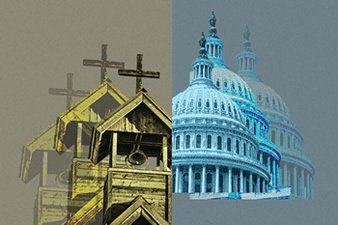
Today, when many people speak of the separation of church and state in America, they often describe it as a wall meant to keep religion out of public and political life. According to them, churches should stay silent on moral issues. Schools should never mention biblical teachings. Government must strip away any reference to faith or God. However, this interpretation fundamentally misrepresents what America’s Founders actually believed and intended. Understanding what they really said about this principle is crucial to restoring an accurate picture of our nation’s heritage and the true purpose of religious freedom in America.
The Phrase That Started It All
Many people cite Thomas Jefferson’s famous “wall of separation” between church and state as proof that religion should be banished from public discourse. Yet Jefferson’s actual meaning has been distorted over time. When he wrote to the Danbury Baptists, in 1802, Jefferson was actually assuring them, in no uncertain terms, that the government would never be allowed to interfere with their religious practice.
The First Amendment itself makes this clear: “Congress shall make no law respecting an establishment of religion, or prohibiting the free exercise thereof.” This simple statement reveals the Founders’ true intent. They wanted to prevent the federal government from establishing a state-sponsored religion while simultaneously protecting everyone’s right to practice their faith freely. This isn’t a license to erase religion from public life; it’s a guarantee that faith would flourish without government coercion.
James Madison, the primary architect of the First Amendment, wrote extensively on this subject. He believed that religious belief could never be compelled by civil authority, and that genuine faith arises only from voluntary choice. Madison didn’t inist that religious people should remain silent or that biblical principles should be excluded from moral discussions. Rather, he argued that the government must remain neutral in matters of faith. There’s a profound difference between these two positions.
What The Founders Actually Wrote
When you examine the historical record closely, the Founders themselves regularly invoked religious principles in public discourse. John Quincy Adams was quite emphatic about this: “The highest glory of the American Revolution was this; it connected in one indestructible bond the principles of civil government with the principles of Christianity.”
George Washington, in his Farewell Address, stated: “Religion and morality are indispensable supports” to political prosperity. He wasn’t warning against the influence of faith in public life; he was affirming its importance to the nation’s well-being.
John Adams declared: “Our Constitution was made only for a moral and religious people; it is wholly inadequate to the governance of any other.” Adams understood that a free society requires citizens grounded in moral conviction. He never suggested that such conviction should be private and hidden.
Thomas Paine, the author of Common Sense, warned against tyranny in religion but never argued for the elimination of faith from public affairs. He wrote: “Of all the tyrannies that affect mankind, tyranny in religion is the worst.” Paine sought to protect people from forced religious conformity, not from encountering religious perspectives in the public square.
And Benjamin Franklin, often thought to be among the most secular of the Founders, attended church regularly and supported religious institutions with his resources. When asked late in life about his religious views, Franklin stated: “I’ve lived a long time, and the longer I live, the more convinced I am of this truth—that God governs the affairs of men. And if a sparrow doesn’t fall to the ground without Him noticing, then how is it possible that an Empire can rise without His aid?”
The point these men made, again and again, was simple: government shouldn’t establish an official church or compel belief, but religious people and religious ideas have every right to participate in public and political discourse. As such, the separation of church and state was meant to protect religious freedom, not to create a secular public square stripped of moral and spiritual truth-seeking.
How the Founders Harmonized Faith and Governance
The Founders lived in a world shaped by centuries of religious conflict. In Europe, state religions had persecuted dissenters, executed outliers, and sparked wars at home and abroad. They understood all too well the dangers of mixing political power with religious authority. But their solution wasn’t to remove religion from public life; it was to ensure that religious institutions couldn’t wield political power and that government entities remained neutral in matters of faith.
Look at what they actually did:
Nearly every state constitution contained references to God or Divine Providence
Many colonies and early states had laws concerning blasphemy—not to protect the government but to protect the public
Religious institutions received tax exemptions and in some cases public support
Chaplains were appointed to Congress and the military
Oaths of political office invoked God
The Declaration of Independence references “Creator,” “Divine Providence,” and the laws of “Nature’s God”
This wasn’t the behavior of men who believed religion should be silenced in public affairs. Instead, it was the behavior of men who believed government shouldn’t monopolize religious authority or compel uniformity of belief.
What the Founders rejected was a monolithic establishment, meaning a single state-sponsored Church that enjoyed government privilege and that enforced religious conformity. What they protected was the free exercise of religion, including the right of religious believers to bring their convictions into public discourse and to organize their communities around a shared faith.
The Real Threat They Sought to Prevent
The Founders’ concern was specific: a government powerful enough to establish one religion would eventually persecute those outside that faith. They had seen this pattern repeat throughout history. Their solution was elegantly simple: don’t allow government to establish religion in the first place. This prevents both the domination of faith by politics and the persecution of minorities.
Yet in modern times, their solution has been inverted. Today, many argue that separation of church and state means religious people must be silent during election cycles, that faith-based organizations can’t participate in public debates, and that religious perspectives have no place in conversations about justice, ethics, and morality. In short, this inversion contradicts everything the Founders wrote about and believed in.
When government becomes hostile to religious expression and seeks to exclude faith-based voices from public discourse, it violates the very principle the Founders fought so hard to protect. They sought to prevent government from dominating religion; they never sought to prevent religion from influencing citizens and their moral choices.
Why This Misunderstanding Matters Today
In recent decades, the phrase “separation of church and state” has been weaponized to marginalize religious people and exclude biblical principles from public conversations. Schools avoid teaching the historical impact of Scripture on American law and literature. Public officials worry that expressing faith will provoke accusations of theocracy. Faith-based organizations hesitate to speak on moral issues for fear of crossing some imaginary line.
This chilling effect on religious speech harms everyone, not just believers. When people of faith are made to feel unwelcome in civic participation, entire dimensions of moral reasoning vanish from public debate. Issues of justice, poverty, dignity, and human worth are often best understood through religious and philosophical frameworks. Excluding these perspectives impoverishes our conversations and weakens our ability to address complex problems.
The Founders understood that a thriving society needs the voices, the institutions, and the moral grounding that faith communities provide. They wanted to prevent government establishment of religion, yes. But they never intended to create a secular public square where only materialist or neutral voices are permitted.
Reclaiming the True Meaning
Recovering an accurate understanding of what the Founders meant by separating church and state requires reading their words carefully and in context. It means recognizing that:
They opposed government establishment of religion, not religious influence on public values
They affirmed that genuine faith can’t be compelled, but they never said faith should be hidden
They believed moral and religious conviction strengthens citizenship and public discourse
They protected the free exercise of religion, which includes speaking and acting on one’s beliefs in the public sphere
They created structures to prevent tyranny, not to silence any group of citizens
When faith communities are excluded from public conversation, when religious perspectives on justice and ethics are treated as illegitimate, and when people feel their deepest convictions must be suppressed to participate in civic life, the original vision of the Founders has been abandoned. Worse still, when conformity of religious thought is universally imposed, their most cherished hope has been abandoned: liberty.
The challenge before us now is to recover this understanding and restore a public square where people of faith can speak freely, where religious institutions can serve their communities, and where moral arguments rooted in biblical teaching are welcomed into political discourse. The Founders gave us a framework for this. All we need to do is read what they actually wrote and follow their example of integrating faith and civic participation while preventing government dominance over conscience. That’s the true separation of church and state they envisioned for America.
More to Explore
When it comes to recovering the real story of America’s origins, The Lost Stories Channel exists to help readers with its extensive catalog of blogs, essays, books, audios, and videos. So, if you’ve ever felt that the story you were told about our beginnings as a nation doesn’t add up, that instinct is worth following. The evidence is there. The question is whether you’re willing to look at it honestly, to let it change what you think you already know.