Hosea’s Prophecy, Scattered Tribes, and the Sand of the Sea
Questions Concerning the Hiding and Restoration of the Northern House of Israel
ABSTRACT: The division of the ancient kingdom of Israel into the northern ten tribes and the southern two tribes of Judah set the stage for a complex history marked by the rise and fall of numerous dynasties and the eventual exile of both kingdoms. Central to this narrative is the mysterious fate of the so-called “Lost” Tribes of Israel, who were scattered and who seemingly vanished from history following their captivity by the Assyrian empire. Here we explore the biblical origins of the northern House of Israel’s dispersion, the divine purposes behind it, and the intriguing archaeological and historical evidence that suggests these tribes to the north were never lost to God but are part of a larger story of preservation and restoration. Through a careful investigation of Scripture, prophecy, and historical findings, we examine the complex realities of God’s intention for the scattering of these tribes, their fate among the nations, and the enduring hope for their eventual restoration as foretold in Scripture…
BUT KING SOLOMON loved many strange women (First Kings 11:1); so says The Bible, speaking of the same man who had once been called the wisest man in the world.
The Wisdom of Solomon was said to have been as measureless as the sand on the seashore, greater than all the wisdom of the East, greater than all of Egypt. He was said to have written three hundred proverbs and more than a thousand songs. Solomon was so wise, in fact, that people from every nation in the ancient world came to hear him speak, among them, the fabled Queen of Sheba. (First Kings 4:29-34; 10:1-13) Solomon, son of David, and builder of the splendors of the Temple of God at Jerusalem; Solomon, the man who loved many strange women, and whose many wives eventually turned his heart after other gods. (First Kings 11:4)
So the Lord became angry with Solomon, because in his old age his heart turned away from the God of Israel, so He told him:
Because you’ve done this thing … I will tear the kingdom away from you and give it to one of your own officials. But for the sake of your father David, I won’t do this while you’re alive, but I’ll tear it out of the hand of your son. Still, I won’t tear the whole kingdom from him, but I’ll give him one tribe for My servant David’s sake and for the sake of Jerusalem, which I’ve chosen.
In this way, Solomon went from being the wisest man in the world, unmatched in wealth, power, and prestige, to the man who was responsible for dividing the kingdom of Israel that had stood united for more than a hundred years. Thus, the stage was set for a new chapter in the drama of God’s people.
AND WHAT A DRAMA it’s been, from the moment that Moses led the Israelites through the parted Red Sea, through forty years of wandering through the Wilderness en route to their new home, with just a slight detour at Mount Sinai along the way. Then, triumphantly entering the Promised Land after having conquered the land under the leadership of Joshua, the Israelites settled there—a chosen people separated to their God.
At first, they were ruled by a series of judges, by the likes of Gideon, Jephthah, and Samson. But afterward, the people demanded a king to rule over them; and although God preferred being their King, He eventually relented and provided them with a dynasty of human kings—first Saul, then David, then his son Solomon.
And although the people of Israel seemed at first to have gotten what they’d wished for, there was never a time in the history of these kings that there wasn’t some form of controversy. The issue came down to just one thing: Could a nation borne by the miraculous intervention of a Supreme Being be ruled by that same Deity—whether by His own hand or through some human intermediary?
To this day, sadly, the answer remains very much in doubt.
Story Continues Below
Hosea’s Prophecy, Scattered Tribes, and the Sand of the Sea: Questions Concerning the Hiding and Restoration of the Northern House of Israel
“Digs into one of The Bible’s big mysteries… Showing us that even though history forgets people, they’re not forgotten in the divine sense… The hope for restoration always bubbles under the surface…”
To hear Academia’s essay chat of Hosea’s Prophecy, Scattered Tribes, and the Sand of the Sea, CLICK HERE.

Story Continues From Above
Then, sometime in the days after Solomon had received word that God would be dividing the kingdom, one of his officials by the name of Jeroboam had been traveling just outside of Jerusalem. As it turns out, this man had so impressed Solomon in a recent building project involving the walls of Jerusalem that the old king had put Jeroboam in charge of the entire working force of the tribes of Joseph.
This day, Jeroboam was strolling along, dressed in a new coat, feeling very satisfied about his new station in life, both courtesy of King Solomon himself, when suddenly a strange-looking fellow stepped up to him.
“Hello, Jeroboam,” the strange man said. “I’m so glad, so glad I finally found you.”
“Me? Why me?” replied Jeroboam, squinting his eyes in the harsh glare of the midday Sun, trying to size up this odd fellow as quickly as possible. “Who are you, anyway?”
“I am Ahijah … from Shiloh… I’m called Ahijah, yes?”
Mulling this over for several moments, Jeroboam’s eyes then lit up. “Ahijah … ah, yes, of Shiloh, you say… Are you the Ahijah, then? Ahijah, the prophet?”
“I am, sir,” Ahijah said, respectfully nodding his head.
Jeroboam nodded back. “So nice to meet you, my friend.”
“You’ve heard about me, then? Is that what you’re saying?”
“Certainly; who in Jerusalem hasn’t?” Jeroboam replied, then suddenly growing uneasy. “Say, what’s this all about, anyway?”
“I have message for you—hat’s what this is about.”
“A message … for me? From who?”
“The Holy One of Israel, that’s who—the Lord God Himself!”
Story Continues Below
To hear Kent and Zen Garcia talk about correcting biblical misconceptions, from September 9th, 2021, CLICK BELOW.
Story Continues From Above
Stunned, Jeroboam’s eyes thinned. “The Lord God? What on Earth are you talking about? What message?”
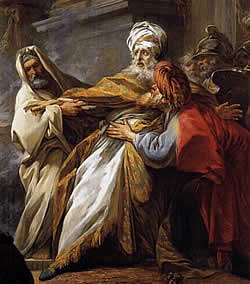
Without warning, Ahijah thrust his hands forward and grabbed hold of Jeroboam’s new coat.
“For God’s sake, man!” Jeroboam snorted. “What are you doing? Keep your hands off me!”
A struggled then ensued as each man jockeyed for position, but clearly this odd-looking fellow was much stronger than Jeroboam had anticipated and before he knew it, the man—this prophet of God?—had removed his coat. And before Jeroboam could say another word, Ahijah started tearing the coat to pieces right before his gaping eyes.
“You crazy fool!” barked Jeroboam. “That was a brand-new coat! King Solomon just gave it to me! Have you lost your mind?”
Tearing the coat into a dozen pieces, Ahijah handed Jeroboam most of them. “Here; you take ten pieces for yourself. This is what the Lord says: I’m going to tear the kingdom out of Solomon’s hand and give you ten tribes.” Ahijah then held up the last two pieces in his hand for Jeroboam to see. “But for the sake of My servant David and My city Jerusalem, his son will get one tribe. As for you, Jeroboam, I’m making you king over Israel; and if you obey Me as David did, I’ll be with you. And in the days to come, you watch: I’ll build you a dynasty as enduring as the one I built for David.” (First Kings 11:29-38)
IN THIS MOST peculiar way, then, God, through the prophet Ahijah, sparked off the revolution that would divide the kingdom, around 900 B.C., with the ten tribes of Israel to the north and the two tribes of Judah to the south.
For the next two hundred years, the northern kingdom of Israel would see the rise and fall of nineteen kings, springing from nine different dynastic families. The southern kingdom of Judah would follow a much different pattern, though just as troublesome. For more than three hundred years, they would see the ascension of nineteen kings and one queen, all originating from the line of David.
Eventually, as a form of divine punishment, both kingdoms were destroyed by invading armies, with the House of Israel being carried away by the Assyrians around 722 B.C. and the House of Judah, by the Babylonians around 586 B.C. But whereas the House of Judah remained fairly intact during their Babylonian captivity, it was the unique fate of the House of Israel to receive the specific judgment of being scattered throughout the nations. That’s when, according to the traditional view of history, the northern ten tribes seemed to vanish from the face of the Earth, and why they became known ever after as the Lost Tribes of Israel.
But is that really the final chapter to the story? Is tradition correct in its view that these so-called “lost tribes” are gone forever, never to be seen or heard from again? Or, as we’ve seen time and time again, does The Bible actually portray a far different picture?
Story Continues Below
Hosea’s Prophecy, Scattered Tribes, and the Sand of the Sea: Questions Concerning the Hiding and Restoration of the Northern House of Israel
“A fascinating deep dive into a biblical detective story… Not just a dusty, abstract debate for old historians… Highlights how academic research is a living conversation…”
To hear Price’s essay review of Hosea’s Prophecy, Scattered Tribes, and the Sand of the Sea, CLICK HERE.
Story Continues From Above
AS I SEE IT, there are three questions we need to answer if we’re to solve this age-old mystery. One, why did God scatter the House of Israel amongst the nations in the first place? Two, if these northern tribes were lost to history, does that mean God lost track of them, too? And three, is it God’s intention that they remain lost forever?
First, let’s look at what the Scriptures say about why God scattered the northern House of Israel. In The Book of Leviticus, we find the origin of God’s intention toward them, when He said:
I am the Lord your God, Who rescued you from Egypt so that you’d no longer be slaves to them… But if you resist My laws, hate My statutes, and scorn My judgments… I’ll oppose you, and you’ll be destroyed by your enemies. And if you refuse to obey Me, I’ll punish you seven times more for your sins.
This same idea repeats three more times, in the next ten verses, and then God said:
And if, in spite of all these things, you still refuse to listen to Me … then I’ll scatter you among the heathen, and your cities will lie desolate. Leviticus 26:33But why would God do something like that? Why doesn’t He just punish the people and be done with it? Why does He have to remove them from the land, too? The following verses explain why.
Then the land will finally enjoy the Sabbaths as long as your land lies desolate and you remain in the land of your enemies. As long as your land remains uninhabitable, then it will rest, even as it didn’t rest during the time that you lived there. Leviticus 26:34-35
So, there’s the answer to our first question. God scattered the people of Israel so the land would be able to fulfill His plan—in this case, concerning the much-misunderstood concept of the Sabbath rest, which typifies what The Book of Hebrews speaks of when it describes the rest that follows the work of faith.
We who have had faith have entered into that rest. Whereas God spoke in another place about the seventh day in this regard: “And God rested on the seventh day from all His works.” Therefore, there remains a rest for the people of God, because whoever enters into His rest has also ceased from his own works, just as God did from His. Hebrews 4:3-4, 10
In other words, when God’s people live according to the precepts of faith, they, too, can expect to rest in that accomplishment, even as God rested on the seventh day of His creation. This, then, is the true meaning of Sabbath rest.
The real significance of this is, for most of the time that the Children of Israel lived in Palestine, they’d lost sight of the true purpose for which God had placed them there. They weren’t there simply for their own sakes; God had a much greater purpose in mind, a purpose they usually squandered. That’s why God removed them from the land, so they might finally turn from their old ways of disobedience, which could only be done after they’d been carried away into captivity. Only then could the Israelites return to the kind of faith they’d all but forgotten about after so many years of false religion, fostered by the belief that they’d always be God’s darlings, no matter what they did to provoke Him.
This brings us to the next question, then.