Lost Stories Gem #5
How Biblical Prophecy and History Confirm Each Other
If you have spent any time exploring biblical prophecy, you have almost certainly encountered the visions of Daniel: the bear with three ribs in its mouth, a symbol for the Medo-Persian empire and the three kingdoms it uprooted; the leopard with four wings, a portrait of Alexander the Great’s blinding speed of conquest, followed by the division of his empire among four generals after his untimely death. These fulfillments are remarkable, and they have been analyzed at length by scholars, theologians, and commentators for centuries.
But here is the honest truth: that ground has been covered thoroughly. Retelling those prophecies would simply mean repeating what is already widely available. At The Lost Stories Channel, the mission is different. The goal is to recover what has been lost to Western readers, knowledge that still exists but sits hidden in plain sight, buried under layers of neglect, political suppression, and institutional indifference.
So let us talk about a prophecy that almost nobody discusses, one that may be the most astonishing confirmation of God’s control over history ever recorded.
The First Promise Ever Made
Most Christians are familiar with what theologians call the “Protoevangelium,” the first hint of a coming Redeemer embedded in Genesis 3. But few are aware of a far more specific promise that Scripture and closely related ancient texts preserve from that same moment in Eden.
According to a remarkable body of ancient literature, including the pseudepigraphal text known as The First Book of Adam and Eve, God spoke directly to Adam and Eve after their expulsion from the garden. He told them that after five and a half “days,” He would send a Redeemer into the world in the flesh to rescue them and their descendants from the ruin that sin had caused. The key to understanding this promise is recognizing what kind of “days” God was counting. These were not 24-hour periods. These were divine days, each one equivalent to a thousand years of human history, following the framework of Psalm 90 and Second Peter 3:8, where a thousand years in God’s sight is as a single day.
Five and a half divine days, then, equals 5,500 years. God was telling Adam that the Incarnation of Christ would occur precisely 5,500 years after the moment of the Fall.
Why This Timeline Is Unique in Prophetic History
Here is what makes this prophecy stand apart from everything Daniel or Isaiah or Jeremiah ever recorded:
Daniel’s prophecies must be verified against secular historical sources that exist outside the biblical record. That is not a flaw, but it does mean the confirmation rests partly on non-scriptural ground.
The 5,500-year prophecy, by contrast, is confirmed by The Septuagint, the ancient Greek translation of The Hebrew Bible that was widely used in the early church. The Septuagint’s chronology from Adam to the birth of Christ adds up to precisely 5,500 years.
This means the confirmation is internal to the broader scriptural tradition itself. It doesn’t require outside sources to validate the timeline.
That combination, a specific numerical promise made to Adam, preserved in ancient extrabiblical literature, then confirmed by the chronology of The Septuagint, is unlike anything else in the prophetic tradition. If Christ truly came in the flesh at the precise moment this promise said He would, then that constitutes a proof of divine control over history that is simply without parallel.
The Trail of Rediscovery
This story of recovered knowledge is itself a story worth telling. Over time, The First Book of Adam and Eve faded from Western awareness. The manuscript tradition survived, but it was scattered, untranslated, and largely ignored by the academic mainstream.
The thread was picked up when E.A. Wallis Budge, working on his English translation of an ancient Syriac text called The Cave of Treasures, wrote plainly in his preface that The Cave of Treasures borrowed extensively from The Book of Adam and Eve. Budge documented that The Book of Adam and Eve recorded God promising Adam, more than once, that after five and a half days, meaning 5,500 years, a Redeemer would come into the world.
Budge also traced the rediscovery of The Cave of Treasures back to the scholar Giuseppe Assemani, who had catalogued a Syriac manuscript in the Vatican Library. That manuscript described a historical chronicle spanning 5,500 years from the creation of Adam to the birth of Christ. But even after Assemani’s description, little attention was paid to it. It was only when August Dillmann, the nineteenth-century German Orientalist, began comparing The Cave of Treasures in Syriac with the Book of Adam and Eve in Ethiopic that the connection became undeniable. Whole sections of the two texts were found to be identical. The lost thread was found again.
This is exactly the kind of recovery that The Lost Stories Channel exists to document: wisdom that was never truly gone, only waiting for someone willing to look.
What The Septuagint Adds to the Picture
The Septuagint’s role in this story deserves its own moment of attention. The early Church relied heavily on this Greek translation of The Hebrew Scriptures, and its internal chronology has long been a subject of debate. But when that chronology is measured from Adam to the birth of Christ, it arrives at the same 5,500-year figure that The First Book of Adam and Eve records as God’s promise.
This isn’t a coincidence that can be waved away easily. The Septuagint was not composed with the intention of validating an obscure promise from Adam. It was a translation project undertaken by Jewish scholars centuries before Christ was born. The fact that its numbers happen to align with the precise timeline of the ancient Adamic promise is the kind of multi-source confirmation that, as The Lost Stories Channel describes it, can only emerge when artistic, scientific, and theological perspectives are considered together rather than in isolation.
You can explore more of how ancient literary treasures from antiquity illuminate these connections in The Book of Tales, which examines how texts recovered from the edges of the biblical canon continue to provide building blocks for understanding our deepest origins.
The Broader Principle at Stake
What this prophecy ultimately demonstrates is something that runs through everything produced at The Lost Stories Channel: truth does not belong to any single discipline. A historian working alone might note The Septuagint’s chronology without knowing what to do with it. A theologian working alone might read The First Book of Adam and Eve without connecting it to the Septuagint. A scholar of ancient manuscripts like Budge brought the pieces together simply by being willing to look across disciplinary lines.
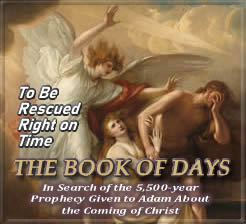
The same principle that Budge applied to ancient texts is what The Lost Stories Channel applies across every volume in its catalog, from works on America’s founding ideals to investigations of ancient mysteries and theological misconceptions. The Book of Days, for example, pursues this very question of how The Great Pyramid of Giza and its connection to biblical timelines defies dismissal as coincidence.
The 5,500-year prophecy isn’t an isolated curiosity. It’s a window into how God operates across long stretches of human time, keeping promises made in the darkest hour of human history, and doing so with a precision that only becomes visible when we are willing to look at the evidence from more than one angle.
If this kind of investigation is what you have been searching for, the catalog at The Lost Stories Channel is a good place to continue the journey. The stories are there. They have always been there. They were simply waiting to be found.