Lost Gem #16
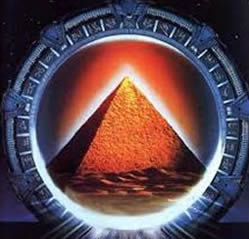
What The Great Pyramid of Giza Has to Do With Enoch
Enoch stands among the most enigmatic figures in biblical history. The Book of Genesis gives us tantalizingly few details: he walked with God; he lived 365 years; and then, he was “taken away.” Yet the apocryphal record describes something far more remarkable.
It tells the story of a man who soared through a hole in space and time, where space was without limit, and time stood still. This journey took him to a land where all legends and lore collide, where the man found himself standing before the Face of God, the Lord of Eternity Who holds space and time in the palm of His hand. Then he was given a pen of quick-writing and told to write as fast as he could, to record the stories of everyone’s lives—of those who have lived, of those who were living, and of those who were yet to live. And after he was done writing, he wondered what he should do next. Until finally, he realized he had no choice in the matter; he had to share what no one but him had witnessed before.
This, in turn, leads us to yet another mystery, one that has captivated theologians and pyramidologists for centuries: What does this ancient prophet, Enoch, have to do with The Great Pyramid of Giza?
The Number That Connects Two Worlds
The answer begins with a single number: 365. Not merely a coincidence but a thread woven into Scripture and stone alike.
According to Genesis, Enoch lived 365 years before God took him. This was no random lifespan. That very number represents the solar year, the time it takes Earth to complete one orbit around the Sun. Before modern science determined this measurement with precision, before telescopes and instruments, the lifespan of Enoch already proclaimed it. As such, a child in any Sunday school can understand from this that when God called Enoch home at 365 years, He was leaving behind a numerical signature that has echoed down through the ages.
Now consider the dimension in the construction of The Great Pyramid. When nineteenth-century British archaeologist Flinders Petrie measured its base with unprecedented care, he discovered something extraordinary. The four sides of the pyramid’s foundation bore slight indentations at their midpoints. Subsequent researchers realized these indentations revealed three distinct measurements corresponding to three known variations of the solar year: the tropical (365.242 days), the sidereal (365.256 days), and the anomalistic (365.259 days).
This was no accident. This was divinely-inspired architecture speaking in a mathematical language.
The Enoch Circle: Hidden in the Depths
Inside the Great Pyramid, at the very heart of its design, lies something even more remarkable. To reach the King’s Chamber, visitors must first pass through the Ante-Chamber. Within this smaller room, if one draws a circle according to the chamber’s dimensions, that circle yields a circumference of precisely 365.242 pyramid inches. This circle has a name: The Enoch Circle.
Pyramidologists have discovered that this same measurement appears again at the distance from the Ante-Chamber’s midpoint to the south wall of the King’s Chamber. What’s more, the number 365.242 appears not just once or twice, but it appears throughout The Pyramid’s entire geometric design—in the dimensions of its passageways, in the relationships between its chambers, in the very proportions that define its magnificent splendor.
Adam Rutherford, one of the leading pyramidologists of the last century, observed: “The entire geometric design of The Great Pyramid is built upon The Enoch Circle. Its circumference, diameter, and radius are respectively 365.242, 116.26, and 58.13 geometric, or pyramid, inches. By geometric symbolism, the representation of Enoch is stamped on the entire Pyramid from top to bottom, inside and out. No wonder that The Great Pyramid is traditionally associated with Enoch, and that Masonic tradition alludes to this Pyramid as The Pillar of Enoch.”
The Truth About a Man’s Lifespan
So why would an ancient structure incorporate a man’s lifespan into its foundational mathematics unless that structure was somehow connected to that man’s purpose?
The most obvious reason is how it reinforces the idea that the God of The Bible is a God of Set Times. Incorporating this number into so many aspects of The Pyramid’s design was Enoch’s way of revealing a singularly pivotal aspect of biblical truth: the concept of time isn’t merely a human contrivance; it was specifically ordained by the Creator. Without the Earth revolving around the Sun every 365.242 days, there’d be no such thing as day turning into night, or days turning into weeks, or months, or years. Therefore, there’d be no such thing as the passage of time. Without the passage of time—not to be confused with the perception of time—there could be no consummation of the “set times” of God, and without these “set times,” there’d be no possibility of human redemption as it’s revealed in Scripture.
Who Laid its Cornerstone
So, having offered evidence of who designed The Great Pyramid of Giza, where can we look for the answer of how its massive structure was built? Whereas archeologists insist it was built by an Egyptian workforce under the watchful eye of the pharaoh Khufu, theologians are quick to point to a biblical book that contains the most obvious allusion to The Pyramid in all of Scripture. “Then, from out of the storm, the Lord spoke to Job: ‘Where were you when I laid the Earth’s foundation? Who marked off its dimensions? Who stretched a measuring line across it? Upon what were its footings set, or who laid its cornerstone while the morning stars sang together, and all the sons of God shouted for joy?’”
Notice the last portion of this passage: “Upon what were its footings set, or who laid its cornerstone while the morning stars sang together, and all the sons of God shouted for joy?” Strange as it may seem, I believe this seemingly insignificant portion of canonical Scripture not only holds the key to further solidifying Enoch as the designer of The Pyramid, but it also helps to solve the mystery of how it was built. To make this point clear, though, we must first analyze more details involved in our quest.
A Colossus Contradiction
In the Great Pyramid of Giza, we’re faced with an innumerable list of perplexing anomalies. In an age before pulleys, wheels, or iron tools, the builders of The Pyramid still managed to enlist the use of an estimated two and a half million stone blocks, each averaging two and a half tons. The result was a colossus that covers nearly sixty-four thousand square yards, weighing an estimated six million tons, and which, for more than four millennia, stood as the world’s tallest structure. In today’s terms that would mean that enough stones were employed in its construction to build thirty Empire State Buildings or sixty-five Washington Monuments. Yet for all its massiveness, scientists have determined that it’s more closely oriented to true north than any other edifice known to mankind, only missing the mark by less than three minutes of one degree. Modern man’s best efforts, on the other hand, as exhibited in the Paris Observatory—completed in 1671—produced results that were six minutes off course.
Add to this the fact that the dimensions of this mammoth megalith incorporate the numerical values of both pi and the solar year throughout its construction, and wer’e faced with an insoluble conundrum. Even if we could explain how these pre-Iron Age builders erected such an edifice, this still can’t explain how they knew to incorporate knowledge that was not discovered until centuries after the assumed date of its construction—in the case of pi, around 1,650 B.C., and the solar year, around 150 B.C. Furthermore, when one considers the added occurrence of its numerous other astronomical design features—among them, the spherical nature, rotation, diameter, density, and temperature of the Earth—one is forced, by the sheer process of elimination, to reject every potential candidate that either the scientific or theological community has yet to offer.
Enoch and an Insoluble Mystery
To the best of our ability, then, we’ve narrowed down our choice for The Pyramid’s architect to a single candidate: Enoch, who alone possessed an understanding of the celestial mechanics of the Universe and the prophetic knowledge of human history. Yet this still doesn’t explain how Enoch managed to turn this special knowledge into the enigmatic megalith that is The Great Pyramid. It is, after all, one thing for God to reveal such mysteries to Enoch, and have him write the books that depict the future of mankind. It is, however, a very different matter to convey this knowledge in terms of everything involved in The Pyramid’s construction, with its internal network of passageways and chambers that have all maintained their geometric relationships in spite of centuries of the crushing weight bearing down on them.
This is particularly pertinent when we consider the added presence of what is certainly the most perplexing feature of The Pyramid’s interior, that is, the four so-called “air shafts” located within its interior. Two shafts lead from the King’s Chamber diagonally up to its exterior, one connecting with the north face and the other with the south face; while two more similar shafts were discovered leading from the Queen’s Chamber. Ignoring, then, all the various interpretations of their true significance, these shafts present yet another glaring conundrum to anyone who considers the incredible lengths that such design features would impose upon their builders, causing many an investigator to contemplate the staggering difficulty in engineering shafts that cut through more than two hundred feet of solid core masonry, and all in an age prior to pulleys, wheels, or iron tools. No wonder that such an insoluble mystery has caused some to speculate that because no earthly technology could have accomplished such an impossible feat, The Great Pyramid must have been built by some otherworldly race of beings.
A Heavenly Construction Crew
Ironically, though, such apparently outrageous conclusions might, as so often happens, actually contain the germ of truth we need in asking how The Great Pyramid was built. Remember how we mentioned that, not only does Enoch fit the bill concerning his knowledge of celestial mechanics and prophetic wisdom, but he is also the only candidate associated with those strange characters known as the Watchers—angelic beings thought by many biblical scholars to be the same ones referred to in the sixth chapter of Genesis? And remember my statement that I believed a verse in The Book of Job might hold the key to this mystery? “Upon what were its footings set, or who laid its cornerstone while the morning stars sang together and all the sons of God shouted for joy?”
Of course in speaking of these “sons of God,” there is always the obvious question: How could these Watchers find there way into a conversation about the building of a sacred monument like The Great Pyramid, when any biblical student knows that their evil offspring, the Nephilim, were a contributing factor in God unleashing the Great Flood? To resolve this mystery, we again turn to the apocryphal record, where we discover, in The Book of Jubilees, why God allowed these Watchers to interact with humanity in the first place: “In the second week of the tenth Jubilee, Mahalaleel took a wife, Dinah, and she bore him a son. And he called his name Jared because in his days the angels of the Lord descended to the Earth, those who are called the Watchers, in order that they should instruct mankind, and that they should execute judgment and uprightness.”
Several critical points are revealed in this passage that help us understand God’s original purpose in allowing this angelic interaction to take place. These Watchers didn’t just wander onto the scene of their own accord, as it might appear at first glance. The Watchers were commissioned by God Himself to perform a divinely-appointed task. That said, it shouldn’t seem so far-fetched to imagine that these same angelic beings, these Watchers, might have actually been the “construction crew,” as it were, that saw to it that Enoch’s heavenly blueprint was turned into a reality. After all, it’s well known to any biblical scholar the extent to which angels have played a pivotal role in accomplishing God’s purposes throughout human history, particularly in regard to their superhuman strength and abilities.
The Architecture of God’s Timeline
Pyramidologists have long maintained that the dimensions of The Great Pyramid encode a timeline of human history. Its passageways and chambers, when measured precisely, correspond to major events, such as the Reformation, the Exodus of Israel, and the birth, death, and resurrection of Christ. These dates aren’t communicated in words, which are subject to mistranslation and misinterpretation across centuries. They are expressed via mathematics. Incontrovertible. Unchanging. Eternal.
A God of Set Times would naturally employ mathematics to communicate across ages. A God Who ordered the solar year, Who called His prophet home at age 365, Who commissioned angels to build a monument to commemorate His control over history, would leave no room for ambiguity. The message would be written in stone and number, readable by any generation, in any language.
If this interpretation holds truth, then The Great Pyramid becomes something far more than an ancient burial chamber. It becomes a testimony, a pillar of witness, a geometric proclamation that God keeps His promises on time, every time.
Why This Matters Today
We live in an age of fragmentation, where knowledge is divided into competing disciplines that rarely speak to one another. Science dismisses the sacred. Theology dismisses the measurable. But The Lost Stories Channel has always maintained that truth emerges only when artistic, scientific, and theological perspectives are harmonized together.
The connection between Enoch and The Great Pyramid demonstrates precisely this principle. You can’t explain The Pyramid through pure archeology. You can’t explain it through pure mathematics. You can’t explain it through pure theology. Only when you bring all three together, allowing each discipline to illuminate the others, does the deeper pattern emerge. Enoch understood this. The Watchers understood this. And perhaps, if we look carefully enough at the monument they left behind, we can understand it, too.
The tales of Enoch aren’t buried in the sands of time. They are encoded in a collosal structure that has survived those sands, waiting for those willing to see beyond surface explanations and harmonize what science, history, and faith all point toward. The Great Pyramid stands as silent testimony that the God of The Bible is indeed the Lord of Time, and His promises, like its stones, endure forever.