Lost Stories Gem #12
God’s Promises in Ancient Timelines
Christianity rests on something most world religions don’t: a foundation of specific, locatable historical events. Unlike mythological accounts of Greek gods or Babylonian deities, biblical narratives point to moments in time that historians can examine and debate.
Consider the Exodus. Egyptian historical records show a sudden power vacuum exactly when the biblical narrative describes Pharaoh’s army being destroyed. Immediately after, a group of escaped Israelites wandered the Sinai Peninsula for forty years without interference from that same Egyptian military. This isn’t myth floating in abstraction. It’s history that can be investigated.
The same applies to the Resurrection. After Christ’s crucifixion, His disciples hid in fear. Then something changed. Within days, they transformed into fearless witnesses willing to endure persecution and, eventually, martyrdom across the ancient world. History records a complete reversal in their behavior. While skeptics debate what caused it, no serious historian denies the reversal itself occurred.
This is the unique claim of biblical faith: it doesn’t ask you to abandon reason and history. It invites you to examine them.
Prophecy Tied to Measurable Time
Beyond historical events themselves, the biblical narrative includes something even more striking: predictions of those events, given centuries or millennia in advance.
The most famous example is the Seventy Weeks of Daniel. The prophet Daniel received a vision in which God tied the coming of the Messiah to a specific timeline. From the decree to rebuild the Temple of Jerusalem, Daniel predicted, sixty-nine “weeks” of years would pass before the Messiah would be “cut off.” In other words, from that decree would be exactly 483 years until the crucifixion of Christ.
If true, this prophecy turns the Advent of Christ from a surprise into something knowable in advance. God wasn’t catching humanity by surprise. He was announcing His plan through the prophet’s words.
The challenge, however, lies in precision. Historians still debate which decree of King Cyrus marks the starting point, as four different decrees concerning Temple reconstruction are recorded. This uncertainty makes fixing the exact fulfillment date difficult, even for those who trust the prophecy’s validity.
Similar complexities arise with the promise to Abraham. God told Abraham his descendants would be “strangers in a strange land” and enslaved for “four hundred and thirty years” before their exodus into freedom. Yet biblical texts reference multiple timeframes: 430 years from covenant to departure, 400 years of affliction beginning in Canaan, and approximately 215 years of actual slavery in Egypt. These aren’t contradictions but different countings tied to different starting points.
A Prophecy Older Than Daniel
But what if there existed a prophetic timeline that required no such historical juggling? What if it didn’t depend on interpreting secular records or resolving scholarly disagreements?
According to ancient Christian tradition and texts preserved outside mainstream Protestant churches, such a timeline does exist.
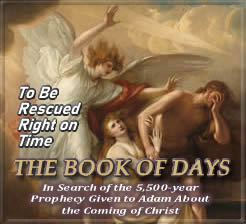
The First Book of Adam and Eve, translated into English from an Ethiopic edition in 1882, contains a promise made directly to Adam and Eve after their expulsion from Eden. God promises that after “five and a half days” in God’s reckoning, which the text interprets as 5,500 years, He would come to Earth in the flesh to rescue Adam and all his descendants.
This promise appears repeatedly throughout the text, chapter after chapter, as a constant thread of hope.
The Gospel of Nicodemus, a work so influential in medieval Europe that it shaped Dante’s Divine Comedy, returns to this same prophecy. In its account of events after the Resurrection, Pontius Pilate interrogates the high priests Annas and Caiaphas about the extraordinary events surrounding Christ’s rising. The priests confess that they had known of the 5,500-year prophecy and that upon consulting their ancient texts, called The Book of the Seventy, they discovered that from Adam to that very moment 5,500 years had transpired. They then reluctantly admitted they had crucified “the true King of Israel, the Son of God, the Almighty Lord” that Israel had long awaited.
The Septuagint and Early Church Confirmation
What validates this ancient timeline most powerfully is The Septuagint, the Greek translation of the Hebrew Scriptures created around 250 years before Christ’s birth.
The Septuagint contains the same 5,500-year chronology from Adam to Christ. This wasn’t a fringe text. Jesus’ own disciples used The Septuagint when writing The New Testament. Early Church Fathers across the Mediterranean world affirmed this chronology because it seemed to confirm, with mathematical precision, that Jesus of Nazareth had indeed fulfilled the primordial promise given in Eden.
This convergence of evidence was remarkably powerful for early Christians. Multiple ancient sources, written centuries apart and in different languages, pointed to the same timeline. Christ’s arrival wasn’t an accident or a coincidence but the fulfillment of a promise as old as humanity itself.
But unfortunately, this consensus didn’t survive the centuries unchanged.
How a Timeline Was Lost
Rabbi scholars, observing Christianity’s rapid growth partly due to this compelling chronological argument, made a fateful decision. They created a revised Hebrew Bible in which they subtracted one hundred years from the lifespans of the ancient patriarchs before the Flood. This alteration compressed the timeline from 5,500 years to roughly 4,000 years from Adam to Christ, undermining the prophetic confirmation that had convinced so many.
For over a thousand years, the Septuagint chronology remained standard across both Eastern and Western churches. No Christian community, even during the darkest periods, adopted the rabbinical revisions.
Then came the Protestant Reformation.
Protestant reformers, eager to distinguish themselves from Roman Catholicism and aware that the Catholic Church followed the Septuagint chronology, adopted the revised Hebrew Bible timeline instead. In doing so, they abandoned a chronology that all Christian churches had upheld for more than a millennium. As historian Nathan Rouse observed, in his 1856 work on sacred chronology, the Protestants did “what no Christian church, even in the darkest ages, had ever done. They adopted the chronological corruptions of the Jewish rabbis.”
Why This Matters Today
The distinction between these timelines isn’t merely academic. The 4,000-year timeline found in our modern Western Bibles offers no confirmation of God’s faithfulness to His promises. But the 5,500-year chronology of The Septuagint and The First Book of Adam and Eve demonstrates something extraordinary: when God makes a promise to humanity, history itself bends to fulfill it, right on time.
This is the power of examining what was lost and recovering what ancient sources preserved. It transforms our understanding of prophecy from wishful thinking into documented history, woven into the fabric of time itself.
The Lost Stories Channel exists to help readers discover these overlooked truths. Whether through books like Tales of Forever that explore God’s faithfulness across millennia, or through blogs and essays that connect faith, history, and reason, the goal is to show you that deeper understanding awaits those willing to look beyond the narratives you’ve been given. Start your own journey of discovery today.